
Webinar: Keeping a Customer Is Cheaper: Ways to Improve Customer Retention
4B Marketing: Business-Focused Marketing With an Edge
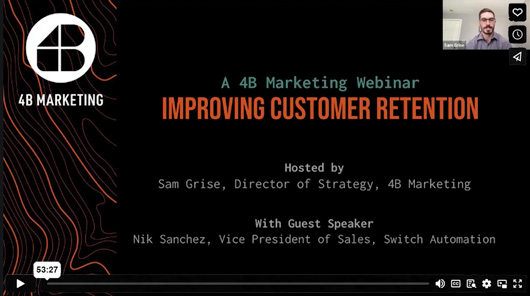
In today's competitive tech landscape, retaining customers is as crucial as acquiring new ones.But what makes a customer stick around? And how can you turn them into advocates? Uncover the answers in our insightful video.
Join 4B Marketing Director of Strategy Sam Grise and special guest Nik Sanchez, VP of Sales at Switch Automation, as we delve into practical tips that not only keep your clients but also turn them into vocal supporters.
Expect to learn:
- Practical strategies to enhance customer loyalty
- Techniques for creating brand advocates
- The impact of customer service on retention
- Tools for monitoring and improving customer satisfaction
- Innovative ways to add value and exceed expectations
Need help with customer retention? contact 4B today.
TRANSCRIPT
Sam Grise, Director of Strategy, 4B Marketing
Nik Sanchez, VP of Sales at Switch Automation
Sam Grise, Director of Strategy, 4B Marketing:
What we’re here today to talk about is improving customer retention. I’m joined today with Nick Sanchez and we’ll start really quick just on a little bit of background of ourselves. Nick, why don’t you go first and then I can talk about 4B Marketing and my roles.
Nik Sanchez, VP of Sales at Switch Automation
Sure. Yeah. So thanks Sam and thanks to 4B Marketing and to all those that are joining for the opportunity to to join you today. My name is Nick Sanchez, I’m the Vice President of Sales at a company called Switch Automation. We are in the building operations and optimization space.
So smart buildings is sort of one of the catch terms that are out there. But my background actually in technology really has always been or generally been largely in the IoT strata. So I started about 10 years ago when IoT was really the internet of everything and mostly vaporware, and have really seen this journey through across, you know, device miniaturization, bringing compute out to the edge, cloud prominence rising. And then ultimately companies like ours which are native or born in the cloud type of companies that are building on software or SaaS type models, or software and a platform software, into service types of models. So before that, I spent some time in the nonprofit sector, did a lot of work with youth organizations and coaching and operations management in those sectors as well.
Sam Grise, Director of Strategy at 4B Marketing
Awesome, awesome. Thank you for that background. And I know we share some history together in the technology space and I know that we share a passion also for coaching, you coaching soccer, me coaching baseball. We’re big athletes and focus on that as well, which plays into customer retention and relationship building that we’ll dive into.
But before that, my name is Sam Grise. I’m the host today. I am the Director of Strategy with 4B Marketing. We’re a marketing agency and really what we do is outcome focused marketing. So all the strategies that we take from, whether it’s branding, webinars, live events, e-mail marketing, so on and so forth, we want to tie it back to that business’s outcomes, whether that’s driving revenue, reducing cost, reducing risk, cash flow optimization and asset utilization. We want to make sure that we’re driving the business forward that we partner with.
And so customer retention is a big piece for us and also our customers specifically that we’re working with previously as well. My career was in the tech ecosystem. I’ve worked for value added resellers, system integrators, global companies. I’ve worked for emerging technology. So very, very versed in the technology ecosystem and that’s actually where Nick and I met and started to build our relationship as friends and partners.
So really fun to have you on today, Nick, to talk about customer retention and the importance of it. Because I think over the past couple years, one, business has changed, right? Relationships have changed, how we engage with customers has changed. But one of the things that stayed the same is acquiring new customers is more expensive than maintaining existing customers. I did some digging, did some research and it looked like most organizations say it’s about five to seven times higher to go find a new customer than it is to retain a customer.
There’s other data points of growth that we can get into about having customer retention and being able to sell into those customers and maintain those relationships and what that can mean for a business. But really today, we wanted to talk about a couple of tips that are extremely important for customer retention. How do you measure customer retention? How do you keep customers? How do you keep customers happy?
How do you go beyond just a P&L and a revenue line to build relationships with people? We hear it all the time from a sales perspective of, hey, people buy from people. So how do you build those relationships, maintain those relationships and continue to grow those relationships. So I think that it starts with one of the biggest pieces in my opinion, when it comes to customer retention, is creating those open lines of communication. We talk about it all the time from a sales perspective of, hey, you need to identify who those key players are in that organization.
But then also I’ve got some buddies in the space, in the tech ecosystem specifically, that have become some influencers if you will on LinkedIn, and have some programs that they work through to help sellers. And one of the things that I keep seeing them say is if I’m not on a texting basis with my champion, odds are that deal’s not going to happen. We’re asking people to invest a lot of money into our business and for us to invest into them. So how do you create those open lines of communications with customers not only to land the business, but when you land it, how do you keep that going?
Because I think a lot of times from a sales perspective, the wining and dining if you will, really being upfront and owning that relationship and really understanding some of those outcomes as we get into a business, sometimes that falls apart. We miss that a little bit. So Nick, would love to hear your perspective on what you do, and as the VP of Sales, how do you create those open lines of communication and how important is that?
Nik Sanchez, VP of Sales at Switch Automation
Yeah. So Sam, I think to answer that or to discuss that, I’ll start by honing in on a couple things that you said. So, and really two topics: one is how we engage and then what we expect and what our customers expect out of that engagement. And so you mentioned in your introduction, right, business has changed in some ways, and some things haven’t.
But the other side of it is you said something there, if I’m not on a texting basis with my champion, then that deal is in jeopardy. And I think that those two things are reflective of these two big points, is that number one, I think during a period where travel, the ability to be in person, was significantly disrupted by a global pandemic event meant that we had to find new ways to engage. And then evolving around us, largely because of technology, has changed the way we engage with everything in our lives. Our engagements with the things that we buy, with the things that we use are now in some ways very impersonal, but in other ways very personalized even though they’re in a digital way. So we start to think about how we had to kind of shift and adjust, to how do we engage with these customers.
So I think the two big factors for me that come out of it when we talk about engaging with our existing customers, and for new customers for that matter, is that you have to be, you have to sort of meet them on multiple levels. I can’t just walk in the door with a box of donuts as frequently anymore. So I’ve got to be able to reach out to them, and I don’t want to be the pest in their inbox, that’s a spam person. So I’ve got to be more creative and be multiple in the way that I engage and be very personal in the way that I engage with you.
And then the second one is that we expect a degree of value of time and then also making sure that it’s apparent that we’re listening. So I think those are the two things that I always try to think about, is how am I making sure that I’m not just always calling and asking for the sale, I’m asking questions about the business. I’m asking questions about our alignment, our performance, what we can do better, those sorts of things. And I know we’re going to unpack some of that a little bit more. So I’ll leave it to those kind of highlights at this point in time.
And then the second thing is, is that there’s an expectation that it’s not a canned or a bulk e-mail. So I think we really need to focus on those sorts of things. It doesn’t mean again, back to one of your points, doesn’t mean that we can’t still send the holiday basket or still send the personalized card around various events during the year. But it means that that’s not enough anymore, and that really there’s an expectation for more than the periodic check in on a personal level.
Sam Grise, Director of Strategy at 4B Marketing
Agreed, agreed completely. And I think that one of the pieces that you touched on there is the bulk e-mail. And I think that really when we talk about an open line of communication from a sales perspective, we talk about multi-threading. And I think that when we send a bulk e-mail, it may not be pertinent information to some of those individuals on that e-mail. They only may need a couple bullet points of hey, what are we doing? What are those key checkpoints? And also, we have so many emails coming into our inbox every single day. Especially if you have a VP title, a Director title, a President title, any of those titles, your inbox is just flooded with emails. And so you want that pertinent information of whatever it may be. And how do you do that throughout a communication strategy within an organization?. And then also how do you get outside of those typical conversations to different areas of the business to have those conversations? And as you mentioned we’ll get into that a little bit more.
But one tip that we have kind of on this open line of communication is going into this next piece which is matching your customer’s flight plan. And one piece I want to touch on that with that open line of communication is you kow as we talked about there’s the texting side, there’s the e-mail side, there’s newsletters, but one of the things that we’ve done is also creating Slack rooms with our clients. So we have that open line of communication with those key persons or key people in the organization that we’re working with every day. How are things going during that day? And sometimes that can be a fun conversation of, hey, I’m up in Beaver Creek this weekend watching the ski races, and you’re getting outside of some of that business side of it as well to really build that relationship.
But I want to touch on this, this matching to the customer flight plan because when we were talking about this, I think that I said journey, I always say journey, that’s an overused term that you brought up to me to say, hey, matching to the customer’s flight plans, a little bit different than journey. And so I really want to dive into this with you. So fill me in on your thoughts on matching a customer’s flight plan and really what that means for what you do in your business today.
Nik Sanchez, VP of Sales at Switch Automation
Yeah, so I think maybe just by way of a very little bit of background there, Sam, is I mentioned in my introduction, I’ve spent a lot of time in the solution space,, IoT and and other types of complex solutions that involve not only a technology stack but a number of services support and often times subscription-related type of engagement with clients. And so the word journey in my world for a long time has come with the connotation of both complexity and also time. And we know, you know, anybody who’s in the sales space knows that time kills deals. And so you have to be delivering value very quickly.
And so in time, I developed this idea with some colleagues around terming things as a flight plan. And the reason I like this analogy is that there is a starting point in a destination, which is the most important thing to the customer. But when we think about booking a flight, like I just came back from a vacation, right, we booked those seats, I expect to walk to get to the airport, get on my plane, get to where I’m going and then begin enjoying my, in this case vacation, maybe it’s on to a business meeting, but that’s really my experience is a very sort of A to B type of experience as the customer in that situation, what it belies is a load of complexity that is abstracted from the experience underneath it. When we think of, and I won’t, but I won’t belabor the point here.
But you think about what it takes to get someone not just booked but then through the airport onto the plane into their seat. All the ground operations, safety and coordination and orchestration that takes place to make that journey A, possible, B, safe and C, complete, that’s the thing that we wanted. So that’s sort of where we started adjusting this language of talking about understanding really where the customer is trying to get, then sort of working to abstract the complexity from their experience while still making sure the journey is both complete, safe and and timely.
Sam Grise, Director of Strategy at 4B Marketing
Totally, totally. I love it. And I also think that it’s important to think about adjusting to that customer flight plan like we’re talking about, what is that end destination. And just because our timing of our business might be different than their timing, at the end of the day, we’re here to support their business. We need to adjust our timing to match their business.
We may have a situation with the company that we see a website or we see some of the stuff that they’re doing on SEO. And we may say, hey, these are items that are important for the business to adjust, but at that time it may be their busy season. We can’t update their whole entire website because of their busy season, right? Just because we think that we can adjust that and make it a more seamless journey. We need to focus on adjusting to their flight plan and what they need to do for the business at that time. And one of the pieces that I like to talk about here is, oh, do you have something there, Nick? I would love to hear it.
Nik Sanchez, VP of Sales at Switch Automation
I was going to interject there because I think you’re, in my language, Sam, you’re talking about outcomes. And so again, I think as a business is oftentimes we have a product and we have a vision for what our mission and how we achieve that mission looks like. And in what we talk about in, what you’re sort of highlighting in the flight plan discussion here is that the customer has requirements, outcomes and objectives that they have to meet as well. And so while we have a delivery mechanism that we see as standard, we have to understand like the analogy you gave which is we can’t be updating the website during their busiest period of time because the user experience being negatively impacted just simply is not an acceptable outcome or impact on that business.
So I think we often times look and say where do we depart from? That’s standard. But then again adjusting that to make sure that we’re aligned and that we also tool correctly to meet the outcomes because not every business objective is the same even within the same sector. We can be talking to clients or users that are in common sectors but have very different outcomes that they’re looking to drive. I mentioned this to you in our prep for this session, Sam, that I talked to our teams about that. When we work with our clients, we’re oftentimes having to message the same technology in many different ways, as many as four or five different ways based on the stakeholder that we’re engaged with. That may be a financial conversation, it may be an operational conversation, it may be a maintenance conversation, it might be an asset valuation conversation.
And again, you know I won’t belabor the point, but you sort of get the intent there, which is that we need to make sure that we’re aligning with not only what we’re delivering, but how it needs to come into the customer’s business as well. We need to set appropriate expectations with that as well, complex outcomes take additional time. Can we deliver minimum valuable product in the interim to make sure that that experience is good for the customer, but also be open and honest about the fact that some of the outcomes may take a little bit of additional time to deliver?
Sam Grise, Director of Strategy at 4B Marketing
Definitely, definitely. And it goes back to that first point of those open lines of communication. If you have those open lines of communication, you can have those discussions. But when you don’t have those open lines of communication, you can’t adjust to the customer’s flight plan and have your outcomes adjusting to that, right? It makes it more difficult if you don’t do that first step and it’s just so important one. because as a customer when somebody comes to you and is open, honest and transparent of saying, hey, here are the steps that we need to do in my language, it’s personalized. It makes me feel valuable as well that I’m being understood from a customer perspective and that we’re truly on this flight path together and not just running in separate directions.
Nik Sanchez, VP of Sales at Switch Automation
And I I know we’re going to move to this right now. So no, go ahead. I think it’s a good transition. I was just going to say that this has to do with asking a lot of questions, right? We don’t know that we are aligned unless we’re willing to ask those questions and so, in addition to asking questions, I’ll also just add, I use this term “be multiple” as we discussed just kind of how things have changed. And I think that’s the other side of it, is not saying what we meet with whatever frequency, that is we meet once a month, once a week, being open in lines of communications so that you’re adjusting along the way. I again think we saw business relationships become at least in structure more personal over the last few years. And I think in our personal lives, we think of this is that I always talk about don’t let little things build up and compile, right, just get them out on the table. And I think that’s the same way we should approach business relationships, which is be able, we want you to feel as a client that you’re able to reach out to us at any time with something, even if you think it’s minor, I’d rather address that along the way than say hold it until the next time that we’re scheduled to meet.
Sam Grise, Director of Strategy at 4B Marketing
Definitely, definitely. And a little bit of background on this slide. For those of you that don’t know. I love this show, Ted Lasso. It’s one of my favorite shows. But in this scene, specifically, Ted Lasso is an American football coach and goes overseas to AFC Richmond to coach a soccer team, or football. And so he’s over there not knowing anything about soccer, having to coach a team and really enjoying it. But in that time there’s a little bit of ownership of that organization that’s going through a battle, if you will. And in this scene specifically, one of the ownership arms basically bets Ted Lasso in a game of darts that he gets to pick the lineup for the next two games, or Ted Lasso said, or you don’t get to go anywhere near the Owner’s Box during the rest of the season, really the ownership team came to Ted Lasso and said, do you play darts? And Ted said, yeah, sure, I could play darts. He didn’t ask, do you like to play darts? You know, do you know how to play darts? He didn’t go into detail of really diving into what Ted knows about darts.
So Ted actually hustles him, plays at the end of the game, hits two triple 20s and a bullseye to win. And he basically says at the end, be curious, don’t assume. Don’t be judgmental. And so when we’re asking these questions, we need to frame them in multiple different ways throughout the organization. And we can have this conversation if you know, if you’re a tech person selling it to the IT director, you can still have conversations with HR, you can still have conversations with operations.
You can still be curious about the business and learn more about the business and what impacts individuals at that business because that’s going to help build that relationship, right? How many IT people are, how many sellers in the IT space are having conversations with HR unless they’re selling an HR software, right? You truly want to be a part of that business, and that’s going to help with that retention phase, is really asking those questions and not just assuming that because they may be a healthcare system that they’ve got so many problems that other healthcare systems have, may have some of those pieces figured out. Just because in healthcare that’s a typical trend doesn’t mean that they have those problems. Start to really dive in and ask those business questions and what’s really impacting them.
The other piece that I would say is you can have a personal level conversation as well of, hey, what drives you, what gets you up in the morning, what makes you excited to work at this organization, right? What are your goals personally for the next 10 years working in this space? What are those pieces? How can you help with those goals that they have individually? That opens up a lot, but also helps build those relationships to where when you’re having conversations from a retention perspective of hey, can we get this done or not, do we need to pull back? What does this actually look like from a business perspective?
Nik Sanchez, VP of Sales at Switch Automation
Yeah, I agree with that, Sam. And I’ll just say maybe to add a little bit, here is what I like about this scene in the context of our conversation, is Ted knew where he was going. The owner that, and I can’t remember his name, but I know he’s sitting off to the side sipping wine in this particular scene, and you know, the thing is that he assumed he knew exactly where this game was going and that he was in control. And I think when we talk about asking these questions, the other thing for our conversation today that I would bring up is don’t assume that just because we’ve aligned before that that’s still where that business is going, right.
We have to continually be curious about how our partner customer and clients businesses are changing as well because we need to continue to be aligned in this flight plan and in this process together, lest we lose sight of the fact that now they’re going in a slightly different direction. So I think that’s the other side of being curious, is making sure that we’re continually engaging in that way. So it’s open and it is transparent. It’s not transactional, but rather it’s a dialogue. So again, I think it’s a great scene, a great show as well, so.
Sam Grise, Director of Strategy at 4B Marketing
Yeah, if you haven’t seen it, I definitely recommend it. It’s a great comedy show. A lot of good life lessons in there too. And I think that that leads us to the next topic, which is keeping the relationship alive, right? How do you continue to engage with these customers?
How do you continue to keep this relationship going? And one of the pieces that you mentioned a little bit earlier is those checkpoints, right, having standard checkpoints, but how do you get outside of those checkpoints for pressing matters that you need to have conversations? One of the things that I’ve always been a big fan of in business with any customer that I’ve had or any relationship that I’ve had is having a quarterly checkpoint for the big things. Hey, look at the market right now. It’s changing like crazy.
You’ve got an election year coming up. How does that impact your business? Those big discussions that need to happen quarterly of, hey, interest rates, what does this mean? Are you going out for funding, so on and so forth. All of those big discussions can happen quarterly. Well, quarterly is not enough, right?
Meeting monthly or biweekly, those kind of checkpoints to understand where are we on the flight plan. Does the flight plan need to adjust because of changes in business, changes in the world? Do we have a pandemic going on? What does this mean for the business? But then also, how do you keep it going outside of that?
And I know that you’ve got some great stories around this from your past life that we want to dive into. So why don’t I pass it over to you, to some of your strategies for keeping a relationship alive.
Nik Sanchez, VP of Sales at Switch Automation
Yeah. So I think you touched on a few things there, Sam, that I’ll maybe just expand upon. So one, I think it remains valuable to have the regular sort of checkpoints, right, very structured and they should be very structured in that way. And so as a business, I think it’s important that we strive for, and people in my team here that that will probably, if they’re on, will probably slam their head against their desk because they’re sick of hearing me say it, is where standardization fails us, we’ll fall back on continuity, which is making sure that there’s a real sort of repeatable way in which we do these things. And so you go to like some of that coach speak, right, which is control the controllables.
So for things like annual business reviews, quarterly business reviews, these very fundamentally structured check insurance, you want to fall back on that like really having a frame of discussion that allows both sides to not only understand the expectations for those engagements, but also to prepare for them. But I think that what has become more important than ever is being able to fill in the space in the middle. And this is one of those things, right? Like if we think of a personal relationship, if we only show the affection and the specialness of a relationship on major milestones like anniversaries, birthdays and holidays, that relationship will suffer. Because it’s the space in the middle in which you affirm that this is important and that it’s a priority.
And so I think that’s where we go back into and yeah, you know the personal anecdotes, you know when we think of what I talked a little bit about in one of our preparation sessions is that even being honest when we’re not aligned. And so I talked about a time when I was coaching, having to say to a particular family and player that look, we weren’t the best fit for them today and that really the best place for that player to go for their particular growth at that point in time was not with our organization, had to be to go elsewhere. And that’s a very difficult message to think of to deliver, one as a stakeholder in the organization that I’m a part of, but also because that’s a really valuable in this case instance player but this might be a valuable client or customer. But to keep that relationship, what’s the effect on both sides of it by straining the capabilities to meet the needs? And I think that’s the point in which you have to find a way to navigate.
And you know the the quick tie up to that is that came back in spades to us because as an organization, because that family not only appreciated that honesty in the moment, but when we were back in a position to meet their needs, they were chomping at the opportunity to get back with the organization. So obviously not everything will work out that way, but I think it’s just this idea of making sure that you’re being honest in the moment, that you’re doing more than simply saying, well it’s the end of the quarter, so we need to have a discussion or it’s mid year, it’s the end of the year, we need to have a discussion, or I’m checking in because there’s a problem. Those sorts of things need to, we need to make sure that we’re conscious of filling the space in the middle because that’s again what helps our clients to understand that that relationship is a priority to the business. And that again we’re remaining curious, remaining engaged with them in the process, that is doing business together.
Sam Grise, Director of Strategy at 4B Marketing
Yeah, I I love that. And the piece that I love is that open, honest and transparency piece of it. You know, we work in a complex world. There’s a lot of things that are out of our control. There are things that are in our control. Flight plans change as we’ve talked about. But being honest and transparent up front, one, gives you a good baseline of, hey, this is where we’re at. And then when something goes wrong because inevitably in business, something’s going to happen, outside pieces are going to come in, their business changes, our business changes, account executives may change on the accounts. There’s going to be a relationship change. Their leadership may change.
All of these things can happen at the snap of a finger, right? It just happens. But being honest and transparent, and what that means for the relationship, for the business where things are sitting with that relationship, goes a long way. Because again, we’re people. We like to go out, we like to go to sporting events, we like to go to movies, we like to do all these things.
We’re people at the end of the day. And so having that honesty and transparency up front helps a ton, helps so much from a relationship standpoint and being able to keep that customer retention. And one of the pieces that, you know, as I was doing research for this, is if we look at kind of the top five players of each market, right, what is their customer retention, their customer retention is about 94%. Well, if you go down each different vertical, retail’s different, right, professional services is an average of about 84%. What does that mean?
What does that mean for your business from a revenue perspective is, you know, with every 5% or so increase in customer retention, right, that’s about 20 to 25% increase in revenue and that goes back to the 80/20 rule, right? 80% of your business comes from 20% of your customers, so on and so forth. But I think it’s so important to have that honesty and transparency because if it isn’t the right fit right now, it could be the right fit down the road. But if you strain the relationship to say, hey, we need to do this for this quarter, quarter mania we talked about, right? Hey, we’ve got to get this in by the end of the month because we need it for our business and so on.
Is that going to strain the relationship to a point where you lose that customer? Because if 5% can increase 20 to 25% of revenue, what happens if you go below that, right? You’re starting to lose that biggest piece, which again keeping a customer is a lot cheaper from a relationship perspective and a revenue perspective than going out and finding new customers. And especially with the model that’s changed in the B2B world specifically over the past three years. We talked about it a little bit, more self-service, people doing a lot more research on their own up front, partially because we’re all stuck in our houses for a year, right? We weren’t having some of those conversations out with sellers and different SMEs if you will, in the space.
Nik Sanchez, VP of Sales at Switch Automation
Yeah. And I guess, Sam, I think it comes back to this idea of being honest not only just in communication, but being honest in the assessment of whether we are aligned. So, I think one of the main overarching things of our discussion today is this alignment, right, alignment around values, alignment around mission or objectives, and the thing I think is that’s a complex space, and we talked about this as we were preparing to do today’s session in the context of, and I’ll just use our very direct example at Switch, our mission is decarbonization of the built space, right. And so we measure that in very specific manners.
Our customers are ultimately doing that thing. They are optimizing buildings and decarbonizing those buildings. But their mission isn’t necessarily decarbonization. Their mission may be energy savings and management, their mission, you know, it may be different than ours. Our values are therefore aligned, but we need to make sure that we’re also aligned on the mission and how we help them to meet that mission, which means for us as a business, the way that they use our tools are different than the next client or customer.
And I think that’s a really important thing about being personal in relationships as well. And then going back to where I started here, which is being honest as to whether or not our businesses are able to be truly aligned on both levels and sometimes understanding that, and I know we’re talking about retention here, I am talking about that hard moment where it’s like we’re not a good fit for one another at this moment in time. But I go back to my story about that player, which is if you’re honest in that moment, but you understand the breakdown, the door is open for you to come back at a later point and talk to that customer and say you remember when we, you know, agreed that we weren’t in the right space to work together? Well, I think we are now and the door will be open for you to have that discussion at that point in time as opposed to if you strain the relationship and fail and now you’ve kind of impacted negatively and you need stakeholder change in order to knock on that door again as a salesperson.
So I think it’s again, I know it’s a bit counter to our our message here today, but I think it it goes to this point of you will always serve your mission as to retain a customer best if you’re continually evaluating, you’re communicating clearly with one another and you’re asking sometimes a question you don’t want to hear the answer to in the interest of making sure that you are aligned both on mission and values.
Sam Grise, Director of Strategy at 4B Marketing
Totally, totally. And I think that that’s a great point because I think that when you have those difficult conversations, one, sometimes you find a path to resolution right away. And I think that that’s a big piece of it, of having those difficult conversations is as a customer, you see that person as a stakeholder in your business. They’re actually trying to drive your business forward. And when you have that and you have that relationship level, those clients are a lot happier and more delighted to work with you. They want to stay with you.
So then when you do have a situation come up later on and two to three years down, the relationship if you will, of hey, can we push this project forward, You know, what does this look like from your business plan, your flight plan, so on and so forth, Then it’s a give and take. Then it’s truly a partnership. But if I come in right away and I’m not honest and transparent and having those difficult conversations and I go, hey, by the way, it’s, you know, Dell’s end of quarter, by the way, can you get this deal done right away? They’re going to tell you, no, see ya. That’s not the person that I want to be working with. And so it’s important to understand that from a perspective of obviously being honest, and we may lose this client at the beginning. But how do we continue to evolve that from a relationship standpoint? Because customers appreciate that, they want the honest, they want the transparency, they don’t want to be pushed around. They’ve got thousands of vendors banging on their door every single day.
For them to replace us is a lot easier than for us to replace them. So we need to be a part of their business to be effective, honest, transparent and continuing to work forward. And I love the aligning that you started to dive into of that mission, right aligning with those values. And I think that it goes into a deeper level, which is the personalization side, which comes into the next phase of it from an alignment of values and so on. So one of our values is creating a positive impact every day.
And so that’s something that we try to do, whether it’s connecting the community, helping people get new jobs, so on and so forth. We want to be a positive impact on our clients. We want to be a positive impact on the personal people that we’re working with. But this personalized side is so interesting because every business is different. Individuals within the business are different, but they have those overarching values from an organization perspective.
And so I used an example of, in my past life, one of my clients, they had a “Cares Day” where every single year they would spend two days for their employees to go out and volunteer in the community. They’d either be packing backpacks for kids coming in to school the new year, they’d be getting boots for winter, they’d go and do Habitat for Humanity. For me personally, that’s a huge passion of mine. I go on Saturday morning sometimes and help out with the brown bag ministry. I go pack lunches, I do food banks, stuff like that.
For me, that is awesome. I love that. And so I want to be a part of that with that organization because that’s a shared value that I have. But also it’s personal. It’s personal to those individuals. Some people are passionate about, hey, I want to help the community with building Habitat for Humanity. Other people want to help children with packing backpacks, right? Those things are so important. And as you continue to personalize those values internally with the organization that you’re working with, it goes a long way.
And I know that you’ve touched on it quite a few times with the personalized side of the house, but I would love to hear if you have any additional thoughts on that.
Nik Sanchez, VP of Sales at Switch Automation
Yeah, I mean, I’ll start by saying it was a bridge that was hard for me to open. I’m a fairly private person in general. But I think there’s a couple things I want to unpack there, Sam. I think one, showing that side of yourself allows your clients to see the person that Sam Grise is and that’s an important element of breaking down the “Sam only shows up when he’s talking about numbers or when he’s talking about the next deal.” So that’s important to kind of humanize yourself because we can become just the sales or that organization that’s there and this is something that we have to sort of work to stave off, and being personable allows that to happen. I think the other side of it is that it does help you to break down those like “it’s OK for you to text me and it’s OK for me to text you. It’s OK for me to forego an e-mail and just pick up the phone and call you.” And I think again, those are things that many years ago, certainly for me, maybe less so for some of the folks in the session today, we’re seeing as there’s a line here like, when do I call, when do I not call? Like I should send an e-mail first and then if I don’t get a response back. So I think there’s those things.
And so, yeah, I guess, you know, Sam knows this about me. I’m never want for sharing a personal story. So just very recently, my family makes tamales every single year in a huge production. We did fifty, almost fifty dozen this year and that’s always within our family been a way to do exactly what we’re talking about today which is to connect. There are elderly folks in our family who aren’t able to get out, and even more so during this pandemic, who weren’t able to get out and see and interact with other families. So doing these tamales every year was our way of then having a way to go and socialize. We bring tamales to these folks’ houses and our family and just spend an hour with them talking and that was our reason, you know an easy reason to go and visit and recently I did share that with some of our clients, and we’re exchanging pictures during this holiday period of the the actual process of this chaos in my mom and dad’s kitchen of people sat around the table in a production and assembly line and myself and my dad out in the garage because it was freezing cold.
So we had to move the cooking operation into their garage. And so you got just things kind of stacked everywhere. But yes, you know, being able to kind of show that side, you know, it just continues to help to say look, I am here for you not simply in a business context. It’s, you know, of course, you know, I don’t expect those customers to start texting me, you know, about random things or for tamale recipes. Although if they did I’d be happy to share it with them, but certainly it just says look it’s OK for you just to pick up the phone and call me and what better way to solve a problem or to talk about what’s next and and get engaged on, hey, we had a customer contact us about this. Is this something that you can help us with? I think I get that call quite a bit, which is we have a client on our side of you know, speaking in the partner’s voice, that’s asking us about this. We’ve never done this with Switch. Is it something you can help us with? Sometimes the answer is yes, most of the time I’d like to think it’s yes. Sometimes the answer is no. But I don’t want to have to have my client or my customer sit behind a screen to feel like they to have to have that conversation to pick up the phone and we can very quickly engage. And I think that’s a sign of a healthy relationship is when we’re not just thinking about “I know where to place that order, but I’m looking at how do I, you know, this is how we grow business together is when we’re looking for new opportunity, not just simply the run rate type of business.
Sam Grise, Director of Strategy at 4B Marketing
I love that, I love that and I think that it goes back from a personal level is awesome. Like we like to work with people we like to work with. We like to have that relationship is one aspect. But then there’s two different things that I want to touch on and one goes back to that multithreading approach.
When you’re personal with somebody and you start to personalize communication, you can understand that the VP of Operations doesn’t need all the minute details of everything that’s going on. They want the three bullet points, or maybe they do want all of the details. But having that conversation and being able to build that relationship, you can learn that so that you can keep stakeholders, leadership up to date I should say of what’s happening, what’s going on. But then also you can be in the weeds working with the team, right? It just depends.
But being able to identify that so that you can keep people privy of what’s going on is so important. But if you can’t get to that personal level of what’s important to you, what’s important to your business, what’s important to your operation, it’s difficult to do that. And that’s where people fall back to the bulk e-mail, the quarterly review and it starts to make it not personal, it starts to make it a transaction-based relationship. And an example that I would share with this is during the pandemic I worked for a technology reseller and everybody was trying to figure out how do we get back together, how do we get back together, right, how do we get in-person? Is it a happy hour? But we can’t get together in person because it’s the pandemic, right? Places are shut down and so on. And so we went out to our customers and had a conversation of, hey, would you guys be open to doing a smoker event once a month? And by a smoker, I meant smoking meat.
We’re going to send you, you know, a grill, if you will, or a charcoal smoker. We’re going to send you the meat once a month. We’re going to sit down on a Thursday afternoon at 2:00PM. We’re going to have somebody come in, do it over Zoom, have some drinks and smoke some meat and hang out. People love it, right?
Nik Sanchez, VP of Sales at Switch Automation
How many of us did a cocktail, a virtual cocktail making session during that as well, yeah.
Sam Grise, Director of Strategy at 4B Marketing
Exactly, exactly. But understanding from a relationship standpoint, some people could care less about grilling and smoking meat. So for them building that relationship and understanding what was going to be impactful to our clients and our customer base to be effective to continue that open line of communication, building relationships was so important.
Nik Sanchez, VP of Sales at Switch Automation
And I think I’ll maybe bring it more into the sphere of having a really productive outcome inside of a meeting in a relationship meeting. I think it goes back to this idea of “be curious.” So we’d like to think that we map very well inside of our clients and we know all the stakeholders, but the reality is, these businesses are complex and then there’s transition and change inside of them. So even for what you might see as a typical meeting, right, like a joint co-selling presentation for example or some sort of other rather standard type meeting.
Understand and know who that audience is. You touched on knowing how to message the, you know, a CFO cares about something very different than a CIO or a CSO, than a lead engineer, than a lead IT person, human resources etcetera. So knowing that audience and asking those questions about, hey, who’s going to be there, what’s the level of tech, you know, technical ability, just knowing how you want to deliver that message and where you want to leave room to get down into the weeds and where you want to sort of avoid kind of losing audience by being more concise. And I think the other side of it, I go back to, you said something a while back, Sam and I missed the opportunity maybe to hold us on it. But I think that today’s collaboration is the future.
So I think the way we engage businesses and clients more and more, the IT person is absolutely talking to the operations person, and so in my world or our world, it’s oftentimes IT and OT, operational technology and infrastructure information technology. But then yes, sustainability stakeholders, the finance people and even the asset managers and these folks are all collaborating with one another. And so we have to sort of create a Demilitarized Zone, right, where not only is the language common, but that we’re bringing those stakeholders into the discussion in a way that it makes their time useful, it values their time. So your messaging is concise and it’s complete, but also that you’re showing them, you’re respecting their different sort of approaches to those discussions, right.
And so knowing who’s in the room, asking those questions to understand who they are and even then taking it one step further and doing that sort of I guess the can term would be “business intelligence.” But going out and you know, spying on LinkedIn and saying let me look at Sam Grise and see if I can understand a little bit about Sam because I’ve never met Sam. And just sort of having a little bit of information and context for yourself, being careful not to make too many assumptions, I think is the thing that I would just throw in at the very end there. I don’t think you should assume that you can know somebody simply from looking at some of their socials.
Sam Grise, Director of Strategy at 4B Marketing
Definitely, definitely. Social profiles are interesting. That’s a great point. It’s a great starting point. It can open up those conversations to be curious, but you don’t want to go in and say, oh, Sam worked at those four tech companies or whatever it was. Oh, he must be a tech guru. I’ll be honest, I’m a sales guy. I don’t know GBICs, I don’t know the hardware side of it. I’ve got SMEs for that. So I understand technology, but I understand the outcomes more than the technology.
So it’s important to be curious and ask those questions even if you’re spying on some LinkedIn profiles. And I think that it goes into the next point really which is our last topic for the day, which is measure and report it. I came across an interesting statistic done by HubSpot that said 44% of businesses are not measuring customer retention, which was just wild to me to think about, right? So from an internal perspective, outward looking, this is an important thing to be measuring, customer lifetime value, customer acquisition cost. I know that I talked about that 5% increase in customer retention leads to 20 to 25% in revenue.
One of the other statistics that I found that was interesting is if you have an existing customer, there’s a 60 to 70% chance of upsell or reselling into that customer that is way bigger than the one shot of trying to get into a new customer. So it’s important to measure it internally from a perspective of what is our customer retention, what are our customer retention goals? Do we have a strategy around customer retention? Is it customer service? Is it that account executive or account manager managing it? Is it us getting our leadership in? What is that strategy to make sure that we’re maintaining those customers?
And the second piece that I would talk about is that open line of communication with the customers. Are you happy? Are you delighted? Where do we need to change? Do we have a personality change that we need to make on our side to be able to be more effective with your business? Having those quarterly business reviews that we’ve talked about or those annual reviews are important to be able to have those conversations but also offline having those touch points of building those personal relationships because if you’re in a quarterly business review, Jimmy Smith might not step up and go, hey, I’m not happy here, you need to be able to build a relationship with Jimmy Smith to go, hey, how are we doing? How are we perceived within the organization? Are we perceived as a partner or are we perceived as a cost? Are we perceived as a business driver? What does that look like? And so would love to hear your thoughts on this as well.
Nik Sanchez, VP of Sales at Switch Automation
Yeah. I think you’re making a great point, Sam. And I guess I would simply say “where can we be better” is a great question. Where is it that that we could have been better and that’s a very open way of inviting criticism and that’s, again that’s OK. But you know, saying “how do you see us.”
You know that kind of, those can be that like somebody’s got to be willing and comfortable enough. But when you go ahead and open the door and say look “where can we have been better, what could we have done.” You know, let’s just assume that we’ve got a scenario where we’re jointly losing an end customer. Well, where could we have been better, what could we have done differently here? And maybe the answer is nothing, you know we’ve seen some of this. The market is brutal in our sector around commercial real estate.
My colleague often times says the box that was always full is suddenly less than half full and it’s been that way now for three plus years. So we’re seeing that impact decisions around asset disposition in our space today. So sometimes the answer is we can’t, there’s nothing we can do because that entity is offloading that asset. But there may be an opportunity to discuss not only what we could have done better but that again goes back to what we’ve discussed earlier which is understanding how we can be better aligned on that mission, how we can talk about how to prevent that next or how we can turn that failure into an opportunity. So I think that those are things and I was making some notes as you were talking there.
I think the other side of this is that complexity is really solved by time and familiarity. So think about this customer retention and being on a flight plan together. It’s one of these things that the better we know one another, the more in line and attuned we are to solving the problems that are in front of us together. And so I think that’s the other reason why customer retention is so important And in our business in a B2B partnership, that familiarity of tools, tooling the partner becomes more powerful, the better that they know us, and the more stable and standard that we can be for them as a partner. So that we can move from partnering to being strategic partners to being like co-selling or even more like OEM type partners is that that’s kind of the the apex of our journey together is when we’re sort of intuitively doing business together. The other thing I brought back is that in my world, measure it, verify it is everything, right?
So we’re in a data-driven world. So we look at it as that that is the single source of truth. And so when we think of it, I think the other things that we talk about around that is one, knowing that those data points are accurate. So making sure that you’re asking the difficult questions of the data that you receive to make sure that your interpretation of that data is true to the actual circumstance that it’s reporting on. Then being able to kind of parse that in and raise it up, we’ve talked about in multiple segments today about there are different understandings or different points of engagement in every relationship.
And I used the analogy before is that in our business it’s the same data sets, but we have to bring that data forward for financial folks, for security folks, for operators, for maintenance vendors, for sustainability heads, for these very different sorts of stakeholders. And so how that data is represented to them and brought to them is really important, but the data still has to be true and the data still has to be, it has to be valid. So I think knowing how to message it and then ultimately again aligning around “well what are we trying to achieve here” and that’s going to build that familiarity and make sure that we’re aligned with it going forward. I think those are the things that we focus on and I think it applies when we measure just customer success, is that we’ve got to be able to look back on it and understand where we started, how we got through challenges or for how we make sure that we can repeat success. And then how we continue to discuss where we’re headed together and not just assume.
I think in our first conversation I used the term “don’t assume that value is intrinsic.” And so again this goes back to that making sure that you’re not just kind of resting on the laurels of the relationship. Ah, we’ve had a great year together, so next year it’ll be great too. That’s never, you know, a safe space to be when we think of relationship management.
Sam Grise, Director of Strategy at 4B Marketing
I love that. I love a couple key points that you talked about. One from like a KPI measurement together, right? What are those goals and objectives? And that’s something that we talk about all the time because we’re an outcomes focused marketing agency.
We want a number on our back. We want to go help drive that business. Well, what are those KPIs that we need to measure to be successful for the business? Let’s make sure we’re aligned on those. And then it comes back to open, honest transparency.
What do we need to start doing? What do we need to stop doing? What do we need to continue doing, what does that look like from a relationship standpoint, from a measurement of driving the business forward of what we’re talking about for the business at that time? So important and I loved the question of “what can we do better?” How many businesses do you think are asking their clients, their prospects, their relationships that they have? How many do you think are actually asking that? Probably not many. They’re going, hey, we got the revenue in this year. This is great, relationship’s great. And you talked about it, just because you got a good year doesn’t mean the next year is going to be great with that client.
And that’s a great question because if we’re talking about open lines of communication, aligning to that flight plan, being open, honest and transparent in our communication of where things are sitting, that’s a great way from a relationship standpoint to say, hey, put it back on us too. It’s not just us being honest, open and transparent with you, come to us, tell us your concerns, raise them, what can we do better. And then I think it goes into as you continue to measure your customer attrition or retention, what could we have done better with that client? What is the postmortem situation if you will, right? What do you have from a relationship standpoint?
What happened during that relationship? What could we have done better? And sometimes you can get the customer to join that call and go, hey, this is where you guys messed up, right? If you can do that, that’s great knowledge for yourself because again, we want to grow that retention rate, easier to keep customers than it is to go acquire new customers.
Nik Sanchez, VP of Sales at Switch Automation
Yeah. And I’m conscious of our time here, Sam, but I just wanted to say something really fast here because I mean what you were talking about there, how many times do you when you don’t get the deal, do you ask for the conversation about why? And I think that for us, we’re a very nimble technology development company because we’re in software. And so for us, it’s always important to understand where do we not win because it may impact our road map, right? It may lead or inform our road map.
We want to know where we’re not fitting and things along those lines. But I think it’s something that again, once you don’t get a deal of the tendency in sales, I got to move on to the one that I can get. But how often do you maybe just hit the pause button and say and ask for that conversation about the deal you didn’t get as well. And you know, you may get some hard truths in that moment, but they can be some of the most valuable insights to your process and to your messaging and other things that’ll really help you to be more successful in your customer retention and even acquisition.
Sam Grise, Director of Strategy at 4B Marketing
Definitely, Definitely. Great point. Great point. Well, I know that we’ve got about four minutes left here, 5 minutes left. We do have some time for questions.
Feel free to use the Q&A if you have any questions or feel free to shoot me an e-mail with the subject webinar. I’m happy to answer those questions as well. We do have an offer of a free hour of support, so feel free to shoot me that e-mail with the subject line webinar. I’ll spend about an hour of time with you answering any questions that you may have on customer retention or marketing in general. So with that, Nick, I want to thank you so much.
Your insight is invaluable for customer retention and sales in general. You’re definitely a leader in the space and we can’t thank you enough for taking the time to sit down with us and the prep work to chat about this today.
Nik Sanchez, VP of Sales at Switch Automation
Yeah. Thanks, Sam, and thanks everybody.