

SEO Is About More Than Excellent Writing
SEO content includes blogs, but there are additional components that work together to improve your search engine rankings.
Search Engine Optimization (SEO) is a content-based marketing style that drives users to the most helpful content on the web. Based on an array of indicators—including uniqueness, authority, expertise, and trustworthiness—your ranking in a search engine can help determine whether or not a user will find your website to be an answer to the question they asked Google.
An excellent writer wields a great deal of power in this world. With a toolkit full of persuasive devices, a writer can reel in readers with relatable statements, shocking statistics, and thought-provoking questions. This talent has been utilized for centuries to convince people to choose one leader over another, one restaurant over another, one marketing agency over another.
Good writing can move metaphorical mountains, but can it conjure the type of SEO success that shifts readers from passive observers to active consumers? It’s a question that digital marketing agencies have asked themselves numerous times over the last decade. Boardrooms and virtual meeting spaces overflow with opinions about the viability of content-based marketing campaigns.
This blog will reveal exactly why SEO is about so much more than excellent writing.
What Is SEO?
SEO—short for Search Engine Optimization—encompasses the effort to improve a site’s ranking organically (without paid advertising). SEO is all about scoring targeted traffic to a website from a search engine’s rankings. The process optimizes a website’s technical configuration, link popularity, and content relevance with the intention of making it easier for users to find the site via a web search on Google or some other search engine (but, mostly Google).
SEO is achieved through a number of tactics, including the creation of high-quality content with specific keywords and the use of backlinks.
When a site page is optimized with SEO in mind, it becomes more relevant toward search queries and ranks higher in search engines as a result. SEO-optimized content fulfills user search needs through the strategic use of relevant keywords in optimized content such as title tags, meta descriptions, headlines, subheadings, and descriptive URLs that feature pertinent terms instead of a string of numbers.
Is SEO All About Content?
Yes! SEO success is driven by content. This can take the form of any useful, high-quality information that you present to the user/potential customer in a manner that’s emotionally engaging and contextually enlightening. Quality content entertains as it informs and generates interest through messaging that answers pertinent questions. This leads users through the buyer’s journey to the desired conclusion: Attract and retain a clearly defined audience and drive customer action.
Content marketing requires your organization to be all in. You will not realize SEO success without constantly creating content for user consumption. Think about how much time you spent on your smartphone or in front of a computer searching for answers. Users will seek out information from whomever is providing it, as long as that information is useful, engaging, and, simply put, there. If you don’t provide answers to search queries, chances are your competition will.
Now, you might hear the term “content” and automatically think “blogs.” This is extremely limiting. Blogs are certainly a pillar in SEO-minded content, but content can also be expressed using a variety of other formats. In this next section, we’ll examine the different types of SEO content and how they build toward SEO success.
What Are Types of SEO Content?
Blog Posts
Blogs have changed drastically over the years. They aren’t just public journals for people’s inane thoughts anymore. These days, blogs are opportunities for companies to establish themselves as an authority in a specific field. And these blogs can take many forms, including lists, guides, how-to articles, and information pieces.
A blog is your chance to answer a user’s question about a product or service before the competition does. Blogs that present high-quality answers that are relevant, smart, and helpful build loyalty, making you a trusted source for any future queries. And with the right SEO juice, your blog posts will rank higher in a Google search.
Product Pages
Product pages—an integral part of your overall site page map—are particularly valuable for e-commerce retail companies. A well-optimized product page does a lot of the heavy lifting, luring in highly targeted, specific individuals who are ready to convert from their position at the bottom of the funnel.
To successfully attract the right kind of traffic, a product page must possess a handful of time-honored characteristics in the backend, such as:
- A robust keyword strategy
- Optimized titles and meta descriptions
- Unique product and meta descriptions
- Structured data
- A well-researched FAQ section
- Customer testimonials and reviews
- Landing pages
- Good quality video and images
- Reduced page load times
- Audited for technical issues and accessibility
Videos
While there are billions of pages and posts on the internet, there are fewer videos. As such, it’s potentially easier to rank on the first page of a Google search for competitive keywords by creating a video.
Videos are a great way to attract an audience that might not click on an article. Depending on the type of business or website, you could create video tutorials on how to use a product. This is a highly valuable form of content. It provides a unique service to users and likely answers a specific question about a product or service. For SEO, it’s a good idea to include a written transcript for your video.
Infographics
Infographics are large-format images that contain useful data, typically in the form of graphs or charts. Covering a single subject, a well-thought-out and beautifully designed infographic will rack up a lot of page views and links. Since the content is embedded in an image, it won’t be readable as text by the Google search engine, so it’s imperative that you carefully optimize the rest of the page for SEO.
Glossaries
A glossary can improve internal linking, page visibility, and your domain authority. Creating a glossary page for your website compiles a list of terms and definitions that are inextricably linked to your area of expertise. This allows users to get an in-depth look at a specific topic and your glossary acts as a go-to landing page for users to return to again and again. What’s more, a glossary improves the components of Google’s EAT ranking factors: Expertise, Authoritativeness, and Trustworthiness. More on that later.
Why SEO Is More Than Great Writing
Content marketing that makes a lot of SEO noise will always rely on strong writing in order to get the message across in a clear, informative way that’s also engaging and entertaining. But beyond a talent for the written word, content marketers must also understand what makes SEO tick. Content marketers need to know:
Who your audience is and where they are in the funnel
The marketing funnel describes a customer’s journey, mapping out the route from awareness to conversion and beyond.
Keyword research
This vital information reveals the path to grow your business online. Consistent keyword research tells you what terms people are actively searching for and how competitive those keywords are. This guides your content plan toward increasing organic search visibility, traffic, and rankings.
Paid and free keyword research tools:
- Semrush (Utilized by 4B Marketing)
- Moz Keyword Explorer
- KWFinder
- Ahrefs Keyword Explorer
- Google Keyword Planner
- GrowthBar
- Long Tail Pro
- Majestic
- Keyword Tool
- SpyFu
EAT (Expertise, Authority, Trust)
This concept comes from Google’s Search Quality Rater guidelines and is used by the search engine to determine whether the content is valuable to readers and where it should rank in search results. Using the EAT guidelines, Google’s evaluators measure:
- Expertise of the content creator
- How knowledgeable is the site owner on the subject matter?
- Authoritativeness of the creator, the content, and the website
- How credible is the website publishing the content?
- Trustworthiness of the creator, the content, and the website
- How trustworthy is the website publishing the content?
Google Ranking Factors
There are more than 1.8 billion websites floating around the internet today. Does that mean there are 1.8 billion experts out there, all doling out valuable information? Probably not. Think about it: Anyone with even a passing knowledge of web design can push a site live and make all sorts of unsubstantiated claims. While everyone has the right to do so, spreading false or misleading information isn’t exactly good for anyone.
The fine folks at Google have a way of separating the wheat from the online chaff by elevating websites that present good quality content from a position of authority and sidestepping sources that don’t check the necessary boxes.
Google’s most popular ranking factors include:
- High-Quality Content: Content is king. And content that provides valuable information will always defeat content that doesn’t. Creating content that’s fresh, unique, and helpful for users leads to higher rankings on Google’s search engine page results (SERPs). Google’s algorithm and page evaluators are incredibly advanced. No matter how optimized your site is with keywords, if the content isn’t valuable, you will not crack into the higher rankings.
- Mobile First: When crawling sites, Google uses mobile-first indexing. This means that when evaluating a page, the search engine will use the mobile version of a site. A flawless desktop site is all well and good, but it is ultimately fruitless if your mobile site isn’t up to snuff.
- Page Experience: This relates to a set of metrics that aim to understand how a user perceives the experience of a specific web page. Google’s page experience criteria are far reaching, but specific considerations include if the page runs on HTTPS, if it has intrusive ads, if the content jumps as the page loads, and more.
- Page Speed: Measured by the amount of time it takes for a page to load after a user clicks on its link, page speed evaluates loading, interactivity, and visual stability. If your page is taking too long to load, or doesn’t perform well when it finally loads, your ranking will suffer.
- Backlinks: There’s no doubt that you see yourself as an authority, but when another site references yours as a source of authoritative information, that’s Google ranking gold. Simply put, the more links you have from multiple high-authority domains, the better you will rank for top keywords.
Good UX/UI
User experience (UX) and user interface (UI) design are crucial to the way your website presents to an audience. UX is the journey/experience a user goes through when browsing your website, app, platform, etc.; while UI constitutes the visual portion of what a user sees, whether that is the front end of a website, backend of dashboards, or an app on a phone.
Images (alt text and title text)
A well-placed image can compliment your web copy, adding a pop of color or even a visual representation that leads to a greater understanding of your topic. Reinforcing your message with an image can result in a good ranking in image search results, but you also need to present good alt attributes. Alt text not only improves your page’s message, it also improves the overall accessibility of your website.
Schema (Structured Data)
Schema (Schema.org) is a semantic vocabulary of tags that’s added to an HTML to improve how search engines read and represent your page SERPs. This special markup language explains the outline of your website page to search engines.
Is the Page Indexable?
If Google can’t index your website, the URLs will not make any sort of appearance in the SERPs. In simple terms: When a user types in a query related to your area of expertise, your website will not appear. You need to open your site to be crawled by Googlebot. This means making your site indexable. But what does that entail? Basically, you need to create a sitemap and list the pages you want Google to crawl for and then submit it to the search engines.
How 4B Marketing Can Help With Your SEO Strategy
SEO content writers aren’t just skilled at stringing sentences together, using compelling language, and structuring narratives. The people entrusted to create content for your website have talents beyond the written word. In the content marketing industry, each day is a deep drive into the world of SEO, and new lessons reveal themselves at every turn.
At 4B Marketing, we connect you with our team of SEO-driven content creators who are all exceptional writers. Our content creators use their storytelling abilities to elevate your brand beyond buzzwords and data points while incorporating the major tenets of SEO—ensuring you don’t just exist online, but thrive there as well.

Seth Godin's Thirteen Principles of the Marketer's Mission
I am an extremely slow reader. I tell everyone this fact whenever they hand me a book; “Don’t put this book in my hands,” I’ll say, “unless you’re prepared to not see it again for a couple of years.” Curiously, I have a strong appetite for learning and I put valuable lessons to work in my life as quickly as I can. All I can say is: Thank God for audiobooks.
Recently, I wrapped up listening to Seth Godin’s This Is Marketing. As with all of Godin’s books, it’s a worthwhile read with more than a few nuggets to sink your teeth into and reference during meetings.
Late in the book, Godin recites a list of rules to help people achieve the change they seek. It’s a fantastic list and one I wanted to share throughout the office. Unfortunately, though, unless I wanted to transcribe that list myself through repeated listenings of the few seconds it takes Godin to recite the list, I was out of luck. I didn’t have a printed copy. This is the downfall of consuming books in audio form.
‘He’s gotta have this on his site somewhere,’ I thought. If he does, Google hasn’t found it.
Through the prompting of my daughter, I found myself later that day at Tattered Cover. I decided to see if they had a copy of This Is Marketing. In short order, I located both the book and the page with the passage and snapped a photo of the pages containing the thirteen principles. So, for anyone else, like me, who listened to the book and wanted to reference this list of principles, here are…
SETH GODIN’S THIRTEEN PRINCIPLES OF THE MARKETER’S MISSION:
- “Put people to work. It’s even more effective than money.”
- “Challenge your people to explore, to learn, and to get comfortable with uncertainty.”
- “Find ways to help others on the path find firm footing.”
- “Help others write rules that allow them to achieve their goals.”
- “Treat the others that way you’d want to be treated.”
- “Don’t criticize for fun. Do it when it helps educate, even if it’s not entertaining.”
- “Stick with your tactics long after everyone else is bored with them. Only stop when they stop working.”
- “It’s okay to let the pressure cease now and then. People will pay attention to you and the change you seek when they are unable to consistently ignore it.”
- “Don’t make threats. Do or don’t do.”
- “Build a team with the capacity and the patience to do the work that needs doing.”
- “If you bring positive ideas to the fore, again and again, you’ll raise the bar for everyone else.”
- “Solve your own problems before you spend a lot of time finding problems for the others.”
- “Celebrate your people, free them to do even more, make it about the cohort, and invite everyone along. Disagree with institutions, not with people.”
And, as a bonus, if you wanted the list of marketing books Seth recommends at the end of the book, Redditor u/IAmSimonDell compiled those here.
Marketing is Actually a Subset of Digital Marketing...
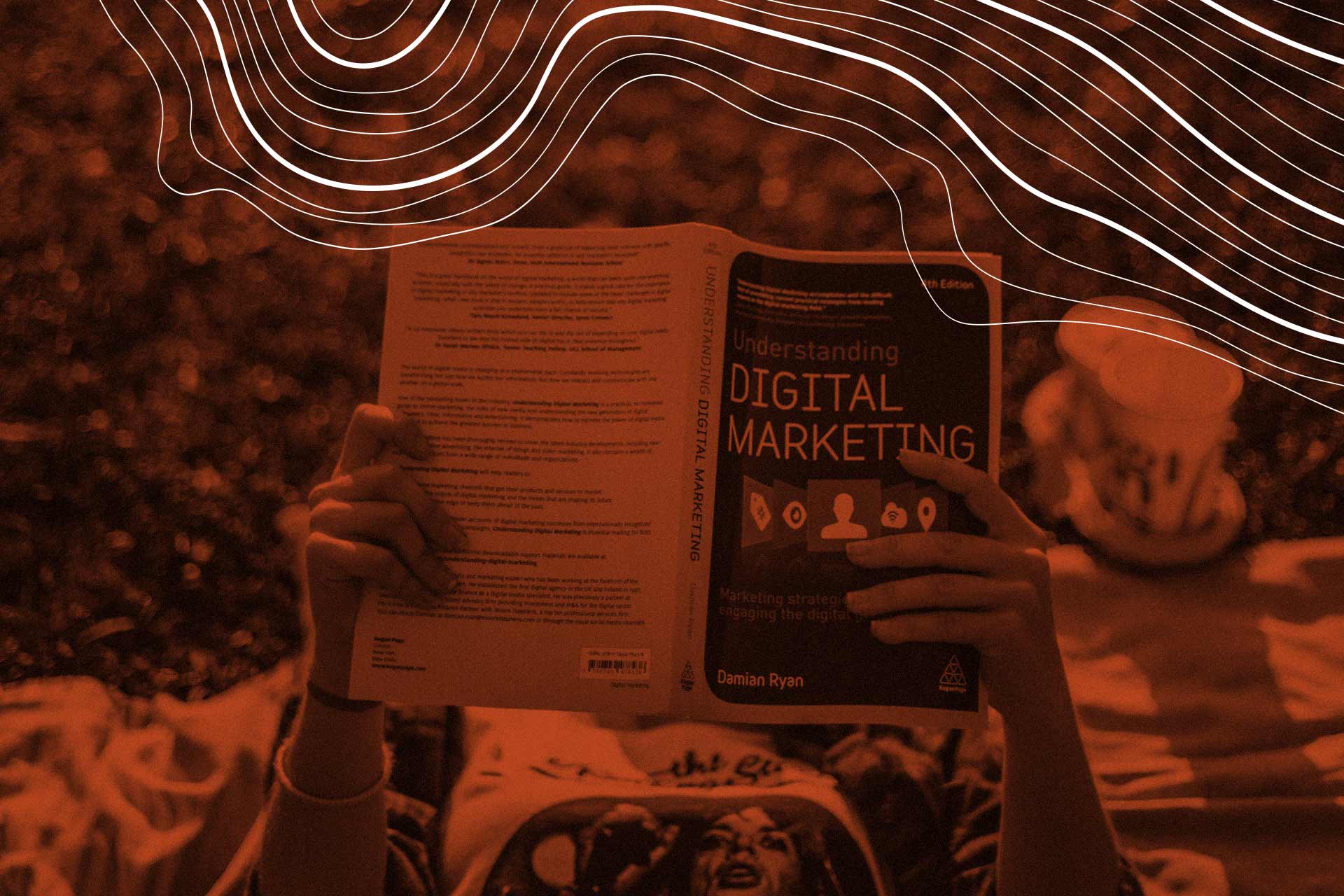
…Or at least I am fairly certain it is. Look, I know what you’re thinking…in this day and age, it seems to be fashionable to make bold, outlandish statements that can be easily proven false. Attention is the new currency, and it can be a totally manipulative hack to grab your attention by simply making a BS claim just to earn a click. Well, let me assure you that my intentions in this article are just, and I ask that you give me a few minutes of your day so that I can make the case that marketing is, in FACT, a subset of digital marketing and not the reverse. Now is this a hill I want to die on? Eh, probably not, but at least hear me out.
Digital Distribution is Generally a Critical Component
Okay, let’s start with the basics. (Cue cheesy 70s public information film music) The dictionary defines marketing as, “the action or business of promoting and selling products or services, including market research and advertising.” Digital marketing is basically any form of marketing that exists online. You’re probably thinking, “well, doesn’t that make digital marketing a subset of marketing then?” You would think so. But let’s dig a little deeper and think about marketing prior to the digital age.
Ever since the first commercial aired for a watch in 1941, the ideal marketing mediums for decades had been tools like billboards, flyers, radio and television commercials, or ads in magazines and newspapers. These were some of the primary methods when I was a kid back in the totally radical 80s of the last century. Who could forget such advertising gems like Wendy’s, “Where’s the Beef?” catchphrase or Domino’s Avoid the Noid campaign? And don’t even get me started on those Motown-singing California raisins! Pure genius! But while these 80s pop culture footnotes were everywhere and being repeated at work or on the playground ad nauseam, the companies churning them out had to be relatively in the dark when it came to understanding their return on investments. Within these distribution channels, segmentation of your audience was fairly sophisticated given how basic these mediums were. Want to engage unemployed people? Run ads for your trade college during Price Is Right. Want to sell Jane Fonda aerobics videos to moms? Run your message on a commercial break for ThirtySomething. Trying to sell Dad a new home computer? Get that ad in the evening edition of the paper. That’s not even considering segmenting by geographics.
There is a massive advantage digital mediums have over traditional mediums; digital can be inbound and targeted in places where everyone is already spending a disproportionate amount of time…online. We have a working generation that grew up without newspapers and the next generation joining the workforce grew up without over-the-air or cable television. These are your audiences and their analog experience is generally secondary to their digital experience.
Let’s take a look at Facebook as an example. Facebook isn’t simply a tool used explicitly to connect old casual acquaintances and weaken democracy (heavy sigh); it’s a platform where businesses hire marketers to target and tap into prospective consumers. Go ahead, log into your Facebook account right now, take a look at the first ten things that pop up into your feed and chances are, somewhere nestled in between the memes, the misinformation and the minutiae of your elementary chum’s everyday life, you will see targeted ads that are tailored specifically for you! Based on how you react to certain posts and behave on websites that you’ve visited, Facebook is able to pinpoint your interests accurately and deliver ads that you are most likely to engage with.
Digital Marketing Is More Than Just Message Distribution
With message distribution based on the audience’s affinities and behaviors rather than being based on the broad preferences of the platform’s users, businesses are able to affordably get the maximum return on their ad spend using reporting, tracking, monitoring, and analysis. In this case, Facebook’s AI is likely doing some of the marketing for the marketer, attempting to learn from the audience who’ve seen and been active with a brand’s ad(s) to extract better results from the campaigns.
Facebook is merely a single example and if you’re a marketer you probably already know that. Thanks to our modern abilities to house, manage, and leverage the insane amounts of information about any given American and their behaviors, marketers can use these digital platforms to communicate finely-tuned, personalized messages to our audiences where and when they are most likely to act on them.
It will probably escalate, too. What if every digital billboard changed on your way home, precisely when you approached it, to remind you that it’s been a couple of weeks since your last Arby’s Beef N Cheddar? And you’re going to get that ad because the marketer already knows when, where, and how many times you need to see that messaging before you take action. That future seen in Minority Report is probably coming, or is it already here?
Now when you are propagating a message that isn’t easily measured or cannot be measured at all, is that really marketing? It kind of sounds just like advertising (and there IS a difference between marketing and advertising, but that is a subject for another time.) Just like traditional marketing, digital marketing is entirely data-driven; it’s all about measuring the research and optimization of a message. Chances are pretty likely that you’re not getting any solid marketing feedback without it being viewed as a digital measurement.
There’s a simple, sure-fire way of measuring whether or not your business’ advertising, PR and marketing programs are even effective and that measurement is basically this: are you making more money or not?
Of course, this bottom line is really only evident at the end of the journey and in order to arrive at this destination there is a long, hard road you must travel. Have you ever seen one of those “iceberg illusion” graphics that vacationing celebs love to post on their Instagram page? You know, the ones where there are two parts to the iceberg: what people see (the tip of the iceberg above the surface) and what people don’t see (the giant mass just below the surface.) Well, marketing is much like that iceberg: the small tip represents the profits, and that giant mass just below the surface represents all of the strategies that were put into it. A healthy bottom line is, of course, the raison d’être of any business, but in order to get there, you have to put in a lot of hard work, persistence, dedication and other iceberg illusion buzzwords.
If you’re sending postcards, are you making sure your site is getting visits from the zip codes you sent the postcards to? Are you tracking calls from a unique number that exists only on that postcard? Are your branded searches increasing on Google and Bing? Is your click-thru rate increasing on non-branded searches? Let’s face it, it is next to impossible to prove the value of your hard efforts when you are still in the dark ages of marketing. The emergence of digital measurement has caused archaic methods of untraceable marketing to go the way of the town crier in a tricorn hat. If you aren’t tracking at least some of these digital metrics, it’s likely you aren’t measuring the important key progress indicators, and, in fact, aren’t actually doing marketing. You’re probably doing advertising on par with sign twirling and crossing your fingers, hoping that it’s effective. Hope is a fantastic campaign slogan for effective leaders, but it is NOT a marketing plan.
Aren’t The Research Tools of Yesteryear Still Marketing?
 Of course they are, but many of those libraries and focus groups and much of that front end research are experienced online. Unless, Science forbid, the world has been reduced to a post-apocalyptic society where the remnants of humanity live in a dystopian wasteland without internet and computers, marketing technology will continue to advance and evolve with great leaps and bounds. We’ve come a long way from the days of full-page ads for Burnett’s Cocoaine hair tonic in The Saturday Evening Post, or biplanes scrawling out a message in the sky to buy Lucky Strike cigarettes. Nowadays, in the post-digital revolution world where just about everything is done online, there is virtually no separation between marketing and digital marketing.
Your audience data collection, research, distribution, and measurement are probably all taking place in a digital space because they simply must. Marketing IS digital marketing.
Well, there you have it. I think I have done an adequate job making the case that marketing is a subset of digital marketing, even if it was just by stating that marketing has come out of the dark ages and into the age of enlightenment. Now I’m curious…what are your opinions on the matter? Agree? Disagree?